Judges 11:31 records Jephthah vowing an olah (עוֹלָה, 'whole burnt offering'), and verse 39 states he 'did to her according to his vow.' For 1,200 years, every ancient Jewish and Christian commentator read this as a horrific literal human sacrifice that God strictly forbade (Deuteronomy 12:31), before medieval Rabbi David Kimhi proposed lifelong celibacy.
An outcast warlord's pagan bargain in a downward-spiraling book
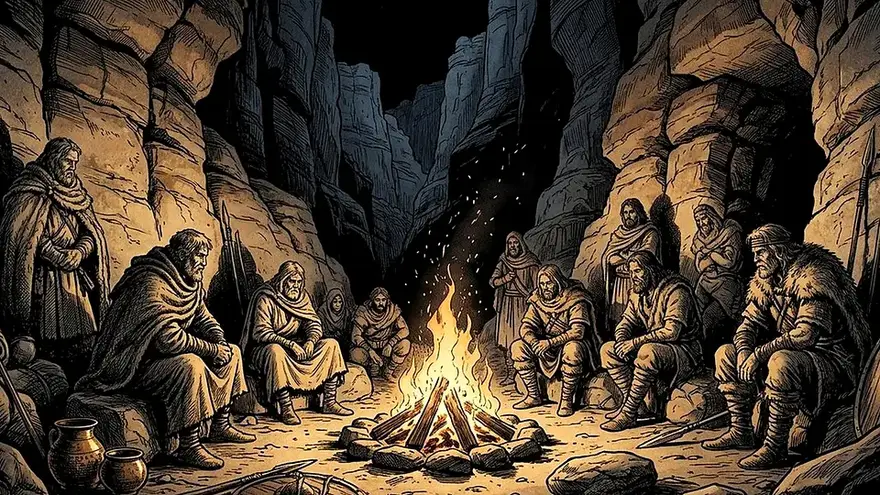
The Book of Judges is structured as a moral landslide where Israel grows steadily indistinguishable from surrounding Canaanite kingdoms. Jephthah, the exiled son of a prostitute from Gilead, knows Ammonite war-culture better than Moses's Torah—even misattributing Moab's national god Chemosh to the Ammonites in Judges 11:24.
Even after YHWH's Spirit empowers him for battle in Judges 11:29, Jephthah tries to bribe heaven like a pagan warlord. He vows that 'whoever comes out from the doors of my house to meet me... I will offer up as an olah (עוֹלָה, whole burnt offering).' Women routinely greeted returning warriors at house doorways with tambourines.
Judges 11:30–31“And Jephthah made a vow to the LORD and said, 'If you will give the Ammonites into my hand, then whatever comes out from the doors of my house to meet me when I return in peace... I will offer it up for a burnt offering.'”
Why It Matters: Around 1200 CE, Rabbi David Kimhi proposed reading Hebrew waw ('and') disjunctively as 'OR'—preserved in the 1611 KJV margin—to spare Jephthah's daughter into temple celibacy, whereas every ancient interpreter read Judges 11 as a horrific, Torah-forbidden human sacrifice.
Scrolls & Archaeology: First-century CE Jewish retelling Pseudo-Philo (Liber Antiquitatum Biblicarum 40:1–8) gives Jephthah's unnamed daughter the poignant name Seila ('She who was demanded') and laments that no sage in Israel annulled Jephthah's rash pagan-style vow before her fiery death. Likewise, Josephus (Antiquities 5.266) explicitly states Jephthah offered his child as a literal holocaust, calling the deed 'neither conformable to the Torah nor acceptable to God.'
Why 'He did to her according to his vow' stunned 1,200 years of readers
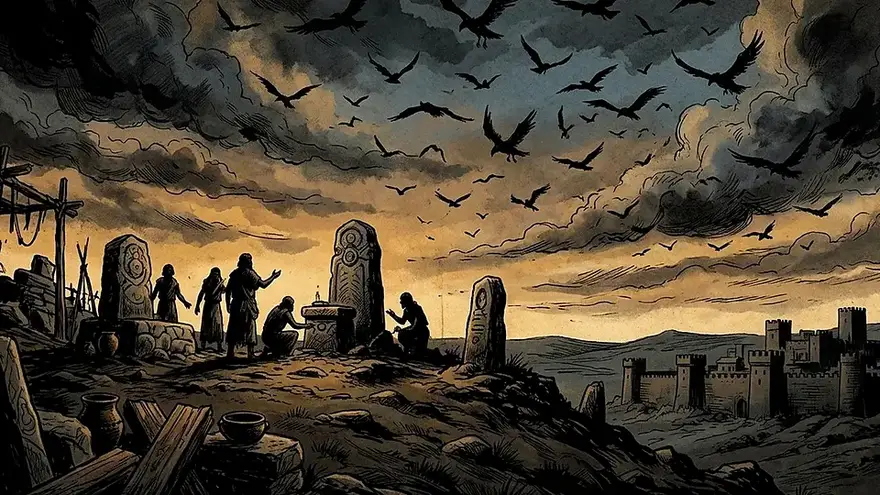
Returning victorious to Mizpah, Jephthah sees his only child dance out with tambourines and tears his clothes in grief. Notice what does not happen next: unlike Genesis 22, where an angel stops Abraham's knife over Isaac, heaven stays completely silent. God never asked for the vow and explicitly condemned child sacrifice in Deuteronomy 12:31 as an abomination YHWH hates.
Even Leviticus 27:1–8 provided a simple silver redemption fee to release rash human vows—either Jephthah did not know the Torah, or his pride refused to back down. For twelve centuries, Josephus, Targum Jonathan, Jerome, Augustine, and John Chrysostom unanimously read Judges 11:39 as tragic filicide.
Deuteronomy 12:31“You shall not worship the LORD your God in that way, for every abominable thing that the LORD hates they have done for their gods, for they even burn their sons and their daughters in the fire to their gods.”
Rabbi David Kimhi's 12th-century 'lifelong celibacy' alternative
Around 1200 CE, French-Jewish grammarian Rabbi David Kimhi (Radak) challenged twelve centuries of grim consensus. Pointing to Judges 11:37–39, Kimhi asked a sharp narrative question: if Jephthah's daughter knew she was about to die in sixty days, why did she spend two months on the mountains 'weeping over her virginity' (betuleiha, בְּתוּלֶיהָ) rather than weeping for her life?
Kimhi proposed reading the Hebrew conjunction vav in Judges 11:31 as 'or' ('shall belong to the LORD, or [if an animal] I will offer it up') and argued verse 39 ('she had never known a man') meant Jephthah secluded her in perpetual celibacy.
Judges 11:38–39“She went with her companions and wept on the mountains for her virginity. And at the end of two months, she returned to her father, who did with her according to his vow that he had made. She had never known a man.”
Weighing the Hebrew grammar: why most scholars still read tragedy
Kimhi's celibacy proposal comforted modern commentators, yet Hebrew grammar pushes back hard. Every single time olah appears in sacrificial contexts across the Hebrew Bible, it means blood and fire on an altar—never lifelong sanctuary service—and ancient Israel maintained no order of cloistered virgin nuns.
In Iron Age Israel, dying before bearing children meant Jephthah's entire family line was extinguished forever, explaining why his daughter mourned her unfulfilled youth (betulim) and why Gileadite women observed a four-day annual lament (le-tannot, לְתַנּוֹת). Judges leaves the horror unvarnished: descriptive narrative is never divine approval, and Israel's judge had sunk to Canaanite religion.
Judges 11:39–40“And it became a custom in Israel, that the daughters of Israel went year by year to lament the daughter of Jephthah the Gileadite four days in the year.”
Two Historic Readings of Jephthah's Vow (Judges 11:30–40)
How ancient consensus and medieval grammatical reinterpretation handle each detail of the Hebrew text.
| Textual Clue | Literal Sacrifice View (Ancient Consensus) | Perpetual Celibacy View (Rabbi Kimhi, ~1200 CE) |
|---|---|---|
| Judges 11:31 — Vow of an olah (עוֹלָה) | Means whole burnt offering on an altar in all ~300 biblical uses | Reads vav as 'or': dedicated to YHWH, OR offered if clean livestock |
| Judges 11:37–38 — Weeping for betulim | Mourning dying unmarried with zero heirs to carry Jephthah's name | Mourning lifelong seclusion without marriage or motherhood |
| Judges 11:39 — 'She had never known a man' | Tragic epitaph underscoring that Jephthah's sole family line died out | Result clause describing her ongoing celibate life after the vow |
| Judges 11:40 — Four-day annual custom | Hebrew le-tannot = 'to lament / recount in elegy' a slain maiden | Translated 'to visit / commemorate' her secluded mountain retreat |
| Key Historical Advocates | Josephus, Targum Jonathan, Jerome, Chrysostom, most modern scholars | Rabbi David Kimhi (Radak), Ralbag, Matthew Henry, Keil & Delitzsch |
What to Remember
- Every time Hebrew olah (עוֹלָה, nearly 300 occurrences) describes an altar vow, it means a whole burnt offering consumed in fire—never metaphorical temple service.
- For 1,200 years (Josephus, Targum Jonathan, Jerome, Chrysostom), all ancient interpreters agreed Jephthah committed literal child sacrifice, showing how thoroughly Canaanite Israel had become.
- Around 1200 CE, Rabbi David Kimhi argued from Judges 11:38–39 ('wept for her virginity') that Jephthah secluded her in lifelong celibacy instead of killing her.