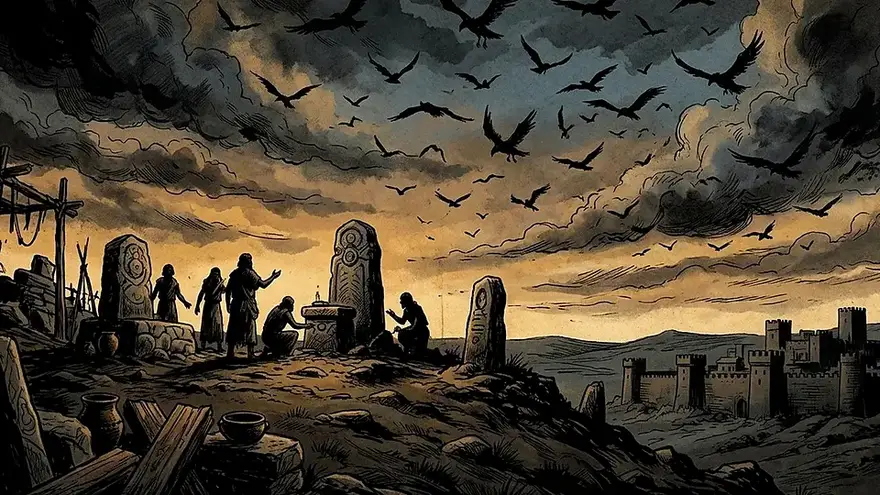

In 2 Kings 2:23–24, the Hebrew phrase ne‘arim qetannim (נְעָרִים קְטַנִּים)—mistranslated 'little children' in 1611—regularly describes youths or young men in their teens and twenties. Outside Bethel's rebel golden-calf sanctuary, a gang of 42+ surrounded lone Elisha jeering 'Go up, baldhead!'—mocking Elijah's whirlwind ascent and triggering Leviticus 26:22's covenant beast warning.
Mistranslation #1: Why 'ne‘arim qetannim' are young men, not toddlers
Nearly every internet meme about 2 Kings 2:23 relies on the 1611 King James rendering 'little children'—back when Elizabethan 'child' could still describe a noble's teenage squire (like Byron's Childe Harold). Test the underlying Hebrew words ne‘arim qetannim (נְעָרִים קְטַנִּים) across Genesis through Kings and the nursery image evaporates.
Hebrew na‘ar denotes an unmarried youth, servant, or soldier—used of 17-year-old Joseph (Genesis 37:2), Absalom's armed troops (2 Samuel 18:15), and 232 military aides in 1 Kings 20:15. Even paired with qatan ('young/junior'), newly crowned King Solomon calls himself a na‘ar qatan in 1 Kings 3:7 at roughly twenty years old!
1 Kings 3:7 (Same Exact Hebrew Phrase)“And now, O LORD my God, you have made your servant king in place of David my father, although I am but a young man (na‘ar qatan).”
Why It Matters: KJV's 'little children' conjures grade-school kids teased for an insult, whereas Hebrew ne'arim qetannim denotes a hostile mob of 42+ young men outside Bethel's rival calf-shrine telling YHWH's prophet to vanish skyward like Elijah just did.
Scrolls & Archaeology: Inside the Books of Kings alone, newly enthroned King Solomon calls himself a na'ar qaton ('young man,' 1 Kings 3:7) around age twenty, and Edomite prince Hadad flees as a na'ar qaton and promptly marries Pharaoh's sister-in-law (1 Kings 11:17–19). Under Sinai treaty law, the two female bears (shtei dubbim) mauling the Bethel mob directly enact Leviticus 26:21–22's specific covenant curse warning apostate towns that God will 'let loose wild beasts' against persistent rebels.

Geography is everything: A 42-plus mob outside idolatrous Bethel
Notice where Elisha is walking in 2 Kings 2:19–23. Down at Jericho, when townspeople welcomed him respectfully, Elisha gladly purified their poisoned spring so women stopped miscarrying. Next he hikes uphill alone toward Bethel—since Jeroboam I (1 Kings 12:28–33), northern Israel's royal headquarters of rival golden-calf worship and virulent anti-YHWH hostility (Amos 7:13).
Streaming out of Bethel's gate comes a pack large enough that forty-two of them are mauled—meaning fifty or more hostile youths cornering one lone pedestrian on an open mountain road. In the ancient world, forty-two young men encircling an enemy prophet outside a rival cult center was physical gang intimidation.
2 Kings 2:23“He went up from there to Bethel, and while he was going up on the way, some youths (ne‘arim qetannim) came out of the city and jeered at him, saying to him, 'Go up, you baldhead! Go up, you baldhead!'”
Mistranslation #2: What 'Go up, baldhead!' (’Alah, qereach!) actually meant
Why chant ’Alah, qereach! ('Go up, baldhead!') twice? Flip back twelve verses to 2 Kings 2:11: Elijah—famous nationwide in 2 Kings 1:8 as a shaggy 'lord of hair'—had just 'gone up' (’alah, the exact same Hebrew verb!) into heaven in a whirlwind, leaving Elisha wearing Elijah's cloak.
Whether Elisha was naturally bald or wore a shaved prophetic/mourning tonsure contrasting with hairy Elijah, Bethel's golden-calf partisans were mocking YHWH's miracle to Elisha's face: 'Your shaggy master supposedly went up into the sky? Go up yourself and get off this earth—or we'll send you after him!'
2 Kings 2:11 (Same Verb ’Alah)“Behold, chariots of fire and horses of fire separated the two of them. And Elijah went up (wayya‘al) by a whirlwind into heaven.”

Leviticus 26:22's covenant sign—and what Hebrew 'baqa‘' actually says
Look closely at verse 24: Elisha neither fights back nor asks God for bears. He turns around, formally invokes covenant judgment 'in the name of YHWH,' and continues toward Mount Carmel. That hands the verdict directly to Israel's own Sinai constitution in Leviticus 26:21–22, where God warned apostate towns: 'If you walk contrary to Me... I will let loose wild beasts (chayyat ha-sadeh) among you.'
Out of the Judean forest burst two Syrian brown she-bears (dubbim) that 'tore into' (watti-baqqa‘nah, from baqa‘, to rip/cleave/maul—not the verb hamit, 'killed') forty-two of the gang, scattering Bethel's mob with a startling public sign that Elijah's God still reigned.
Leviticus 26:21–22 & 2 Kings 2:24“Lev 26:22 — 'And I will let loose the wild beasts against you.' · 2 Kgs 2:24 — 'And two she-bears came out of the woods and tore forty-two of the youths.'”
1611 English Impression vs. 9th-Century BCE Hebrew Context
How checking four Hebrew words transforms the entire reading of 2 Kings 2:23–24.
| Element | Popular Surface Misreading | Hebrew & Historical Reality |
|---|---|---|
| Ne‘arim qetannim | Small six-year-old toddlers playing outside | Youths / junior young men (same phrase King Solomon uses of himself in 1 Kgs 3:7) |
| Bethel setting | Any random village street | State sanctuary of Jeroboam's golden calf, hostile to YHWH's prophets |
| ’Alah, qereach! ('Go up!') | Harmless schoolyard teasing about hair loss | Gang taunt mocking Elijah's whirlwind ascent (2 Kgs 2:11) & telling Elisha to vanish |
| Two bears (Lev 26:22) | Personal petty revenge over vanity | Exact Sinai covenant treaty warning against persistent rebel towns; baqa‘ = mauled/scattered |
What to Remember
- King Solomon calls himself a na‘ar qatan ('little child' in KJV!) in 1 Kings 3:7 when already married and reigning as king around age twenty.
- Bethel was northern Israel's state headquarters of golden-calf idolatry, and shouting 'Go up!' (’alah) mocked Elijah's ascent five verses earlier while threatening Elisha's life.
- Elisha never asks for bears—he pronounces a covenant curse invoking Leviticus 26:22's exact Sinai treaty warning ('I will loose wild beasts among you'), and Hebrew baqa‘ ('tore into') does not say all 42 died.