In Genesis 1:26, God speaks in the Hebrew plural cohortative na'aseh adam be-tzalmenu ('Let us make humanity in our image'), then acts alone in Genesis 1:27 with three singular verbs (wayyivra, 'So God created'). Most Hebrew scholars read this as YHWH announcing His decree to the heavenly Divine Council (compare Isaiah 6:8), while early Christians read it alongside John 1 as a Trinitarian hint.
The grammatical whiplash between Genesis 1:26 ('us') and 1:27 ('His')
Across the first twenty-five verses of Genesis, one sovereign voice speaks creation into existence with singular verbs: God said, God separated, God saw. Then at the climax of Day Six in Genesis 1:26, the Hebrew grammar abruptly shifts to first-person plural: na'aseh adam be-tzalmenu kidmutenu ('Let us make humanity in our image, according to our likeness').
Hold your breath for exactly one sentence and the plural vanishes. Genesis 1:27 hammers three singular verbs (wayyivra... bara) and singular pronouns ('in His image, in the image of God He created him'), echoed by three other mysterious 'us' speeches in Genesis 3:22, Genesis 11:7, and Isaiah 6:8.
Genesis 1:26–27“Then God said, 'Let us make man (na'aseh adam) in our image, after our likeness.' ... So God created (wayyivra) man in his own image, in the image of God he created him; male and female he created them.”
Why It Matters: Genesis 1:26–27 shifts deliberately from plural royal-court deliberation ('Let US make... in OUR image') to three strictly singular creation verbs in verse 27 ('He created... in HIS image'), while plural 'let THEM rule' proves adam includes both men and women!
Scrolls & Archaeology: Unearthed by Syrian farmers in 1979 at Tell Fekheriye along the Habur River, a 9th-century BCE life-sized basalt statue of Aramaean ruler Hadad-yis'i carries a bilingual Akkadian-Aramaic inscription using the exact two Aramaic cognates of Genesis 1:26—tzelem (ṣlm) and demut (dmwtʾ)—interchangeably for a king's physical statue set up to manifest his rule in a province. Whereas Mesopotamian texts reserved the title 'image of the god' (ṣalam ili) exclusively for the pharaoh or emperor, Genesis 1:26–27 democratizes royal image-bearing across every human being.

Why the textbook 'royal we' fails classical Hebrew grammar
For centuries, commentators tried to smooth out Genesis 1:26 by comparing it to Queen Victoria's English 'We are not amused'—calling na'aseh a 'plural of majesty.' Hebrew nouns certainly use honorific plurals like Elohim ('God') and Adonai ('Lord'), which pair routinely with singular verbs whenever Israel's God is the subject.
First-person plural verbs, however, work differently. Standard reference grammars by Paul Joüon and Takamitsu Muraoka demonstrate that classical Biblical Hebrew never puts a lone monarch's verbs into a 'royal we'; throughout Samuel, Kings, and even Persian decrees in Ezra 6:8, kings say 'I.' Something bigger than royal etiquette is happening here.
Genesis 3:22 & Genesis 11:7“Genesis 3:22 — 'Then the LORD God said, Behold, the man has become like one of us...' · Genesis 11:7 — 'Come, let us go down and there confuse their language.'”
Announcement to the Divine Council—compare Isaiah 6:8 and Job 38:7
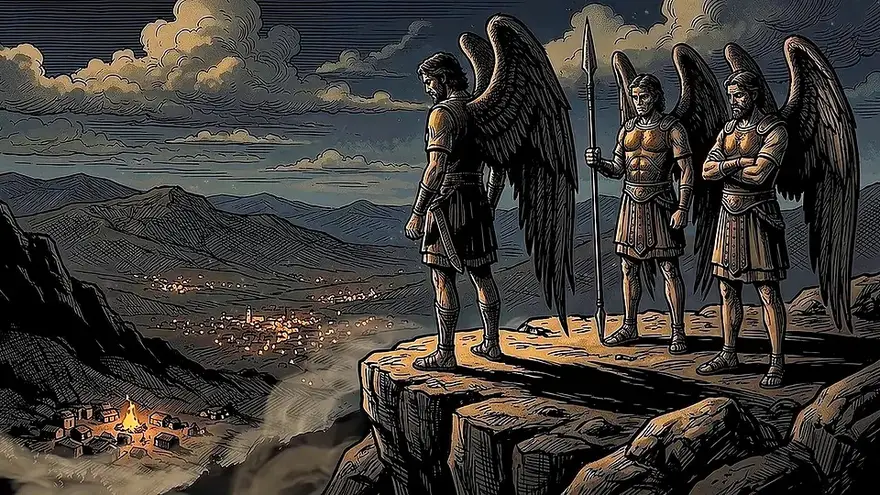
Step inside the Hebrew Bible's own throne-room scenes and the plural clicks immediately. In 1 Kings 22:19–22, Job 38:7 (where 'the sons of God shouted for joy' at creation's dawn), and Psalm 82:1, YHWH presides as King surrounded by a heavenly assembly of spiritual beings who witness and applaud His decrees.
Isaiah 6:8 preserves the exact singular-to-plural rhythm inside Jerusalem's Temple vision: surrounded by six-winged Seraphim, the Lord asks, 'Whom shall I send, and who will go for us?' In Genesis 1:26, God announces humanity's creation to His heavenly court—and then executes the act completely alone in verse 27. Second Temple writer Philo and Aramaic Targum Jonathan both recognized this court setting.
Isaiah 6:8 & Job 38:7“Isaiah 6:8 — 'And I heard the voice of the Lord saying, Whom shall I send, and who will go for us?' · Job 38:7 — 'When the morning stars sang together and all the sons of God shouted for joy.'”

Trinitarian readings—and why 'image' ('tzelem') subverted Egyptian kingship
Starting with Justin Martyr (Dialogue with Trypho 62, ~160 CE) and Irenaeus of Lyons, early Church Fathers read Genesis 1:26 backward through John 1:1–3 and Proverbs 8, hearing the Father converse with His eternal Word (Logos) and Wisdom/Spirit. Christian theologians often hold both horizons together: what ancient Israelites heard as heavenly-court majesty gained fuller intra-divine resonance after the Gospels.
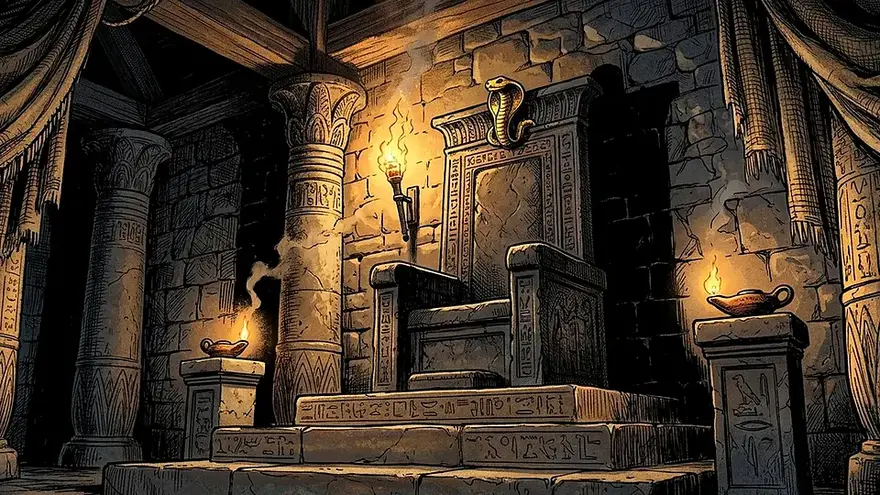
Meanwhile, don't miss the political shock of Hebrew tzelem ('image,' cognate with Akkadian ṣalmu). In Egypt and Assyria, only Pharaoh or the emperor was called the living 'image of god,' planting stone statues across conquered borders—whereas Genesis crowns every human farmer, slave, man, and woman as God's living representative on earth.
John 1:1–3“In the beginning was the Word, and the Word was with God, and the Word was God. He was in the beginning with God. All things were made through him.”
Four Major Explanations of 'Let Us Make' in Genesis 1:26
How Hebrew grammarians, Second Temple rabbis, and early Christian writers read the plural verb.
| Interpretation | Core Claim | Key Strength | Main Objection |
|---|---|---|---|
| Divine Council Announcement | God announces humanity's creation to His heavenly court, then creates alone in v. 27 | Matches Isaiah 6:8 ('for I / for us') & Job 38:7 cleanly | Rabbis worried heretics might claim angels co-created |
| Trinitarian Dialogue | Father addresses eternal Son/Word and Spirit (Justin Martyr, Irenaeus) | Harmonizes Genesis 1 with John 1:1–3 & Genesis 1:2's ruach | Goes beyond what first-millennium BCE Hebrew readers knew |
| Plural of Self-Deliberation | Speaker addresses his own heart in reflective plural cohortative | Preserves strict solo agency without angelic listeners | Rare in Hebrew; fails to explain 'like one of us' in Gen 3:22 |
| Royal 'We' of Majesty | Honorific monarchic speech like modern European royals | Familiar to English readers from royal proclamations | Unattested for verbs in classical Biblical Hebrew |
What to Remember
- Genesis 1:26 uses plural speech ('Let us make... in our image'), yet Genesis 1:27 immediately repeats singular verbs ('God created... in His image') three times so no angel shares credit as Creator.
- Classical Biblical Hebrew lacks a verbal 'royal we' of majesty; instead, Genesis 3:22, 11:7, and Isaiah 6:8 ('Who will go for us?') show God addressing His heavenly court.
- Ancient Near Eastern kings erected physical statues (tzalmim) to project rule across provinces—Genesis 1:26 democratizes that royal office from Pharaoh alone to every human being.