Genesis 5 records ten pre-Flood patriarchs peaking at Methuselah's 969 years, engaging the same ancient Near Eastern memory preserved in the Sumerian King List—where pre-Flood rulers reign 28,800 to 43,200 years—while scaling those claims drastically downward. Every lifespan ends exclusively in 0, 2, 5, 7, or 9, weaving sacred patterns like Enoch's 365 and Lamech's 777.
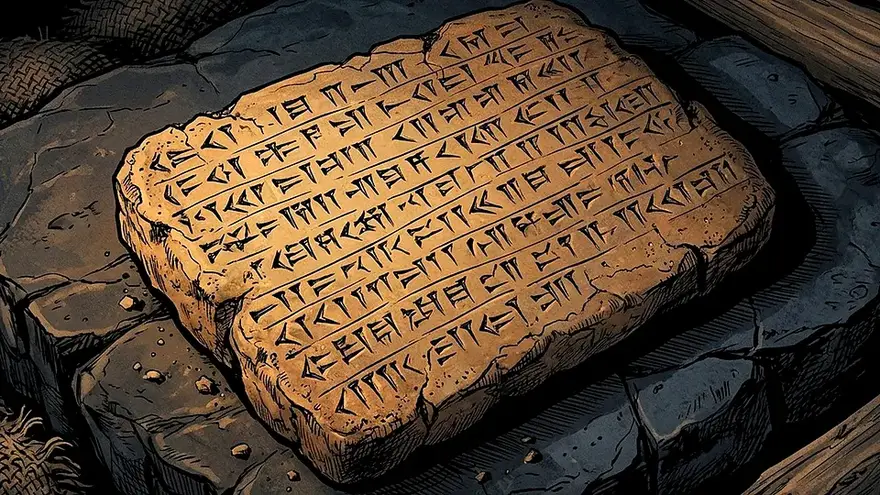
The clay prism in Oxford where pre-Flood kings reign 43,200 years
In Oxford's Ashmolean Museum sits the Weld-Blundell Prism (WB 444), an early second-millennium BCE cuneiform monument inscribed with the Sumerian King List. Its structure mirrors Genesis 5–9 uncannily: a fixed roster of pre-Flood figures (eight or ten rulers in variant tablets), a catastrophic deluge that sweeps the earth clean, and dramatically shorter lifespans afterward.
Yet compare the numbers. Using Mesopotamian sexagesimal (base-60) units where one shar equals 3,600 years, Eridu's first king Alulim reigns 28,800 years and Enmenluanna rules 43,200! Against those semi-divine millennia, Genesis insists pre-Flood humans were strictly mortal—capping even Methuselah below a single thousand.
Genesis 5:5, 27“Thus all the days that Adam lived were 930 years, and he died... Thus all the days of Methuselah were 969 years, and he died.”
Why It Matters: Not only do every patriarch's years in Masoretic Genesis 5 end exclusively in 0, 2, 5, 7, or 9 (never 1, 3, 4, 6, or 8), but the three ancient text-traditions systematically shifted begetting ages by 100-year increments.
Scrolls & Archaeology: Housed in Oxford's Ashmolean Museum, the Weld-Blundell Cuneiform Prism (WB 444, c. 1800 BCE) preserves the Sumerian King List, where eight pre-Flood kings reign a combined 241,200 years counted in base-60 sexagesimal units (sars of 3,600 and ners of 600) before lifespans plummet after the Deluge. Statistical analysis confirms the chance of ten random natural lifespans in Masoretic Genesis 5 avoiding half the digits (1, 3, 4, 6, 8) by coincidence is less than one in a thousand (0.5¹⁰).

Why zero lifespans in Genesis 5 end in 1, 3, 4, 6, or 8
Hebrew Bible scholars Umberto Cassuto and Carol Hill noticed a striking mathematical clue hidden in plain sight across Genesis 5. If ten ancestors died at random biological intervals, roughly half their final ages should end in 1, 3, 4, 6, or 8.
Check all ten totals in Genesis 5—930, 912, 905, 910, 895, 962, 365, 969, 777, and 950: every single number ends exclusively in 0, 2, 5, 7, or 9! Ancient scribes constructed these honorific spans from round five-year blocks plus sacred sevens, honoring ancestral dignity through ordered numerical symmetry.
Genesis 5:1–2“This is the book of the generations of Adam. When God created man, he made him in the likeness of God.”
Enoch's 365 solar days, Lamech's 777, and Methuselah's Flood-year finish
Three ages inside the genealogy broadcast unmistakable symbolic meaning to ancient Hebrew listeners. Seventh-generation Enoch walks with God for 365 years (Genesis 5:23)—matching the 365 days of a full solar year to mark a complete, radiant life.
Ninth-generation Lamech, father of righteous Noah, lives 777 years (Genesis 5:31)—a triple seven directly answering murderous Lamech in Cain's line, who boasted of seventy-sevenfold revenge (Genesis 4:24). And if you total the Masoretic Hebrew fatherhood ages from Adam downward, 969-year-old Methuselah dies in year 1,656—the exact year Noah's Floodwaters break loose.
Genesis 5:23, 31“Thus all the days of Enoch were 365 years... Thus all the days of Lamech were 777 years, and he died.”
The post-Flood taper and what Genesis 6:3's '120 years' means
Right before the Flood, God announces in Genesis 6:3: 'My spirit shall not abide in man forever, for he is flesh; his days (yamim) shall be 120 years.' Ancient interpreters split over two plausible readings: either a 120-year grace countdown until the Floodwaters hit, or a new ceiling on post-Flood human vigor.
Either way, Genesis traces a deliberate curve as humanity moves farther from Eden's Tree of Life: 900s before the Flood, 600 down to 200 in Shem's line (Genesis 11), 175 for Abraham, 120 for Moses (Deuteronomy 34:7), and finally 70 to 80 in Psalm 90:10.
Genesis 6:3 & Psalm 90:10“Gen 6:3 — 'His days shall be 120 years.' · Ps 90:10 — 'The years of our life are seventy, or even by reason of strength eighty.'”
Pre-Flood Lifespans: Sumerian King List vs. Genesis 5
Comparing Mesopotamian base-60 royal reigns against Genesis's scaled-down, symbolic mortal ages.
| Tradition / Era | Key Figure | Recorded Span | Literary & Theological Signal |
|---|---|---|---|
| Sumerian King List (Pre-Flood) | Enmenluanna of Bad-tibira | 43,200 years (12 shar) | Semi-divine royal aura calculated in base-60 units |
| Genesis 5 (7th Generation) | Enoch | 365 years | Matches the 365-day solar cycle; taken by God without dying |
| Genesis 5 (8th–9th Generation) | Methuselah & Lamech | 969 & 777 years | Peak mortal longevity ending at the Flood + triple-seven completeness |
| Deuteronomy 34 / Psalm 90 | Moses & Classical Israel | 120 down to 70–80 years | Post-Flood human horizon fulfilled after Genesis 6:3 |
What to Remember
- On the cuneiform Sumerian King List, pre-Flood kings at Eridu and Bad-tibira reign 28,800 to 43,200 years in base-60 math—making Genesis 5's 900s a bold theological critique.
- None of the ten lifespans in Genesis 5 end in 1, 3, 4, 6, or 8, signaling deliberate base-60/base-10 literary design rather than random birthday tallies.
- After the Flood, biblical lifespans step steadily downward from 600s to Abraham's 175, Moses's 120 (Genesis 6:3), and Psalm 90:10's familiar 70–80.