Uzzah died because King David ignored explicit Torah transport laws (Numbers 4:15), which required Kohathite Levites to carry the Ark on their shoulders using gold-sheathed poles without ever touching it on pain of death. Instead, David copied the pagan Philistines' ox-cart method (1 Samuel 6:7), as David himself later confessed in 1 Chronicles 15:13.
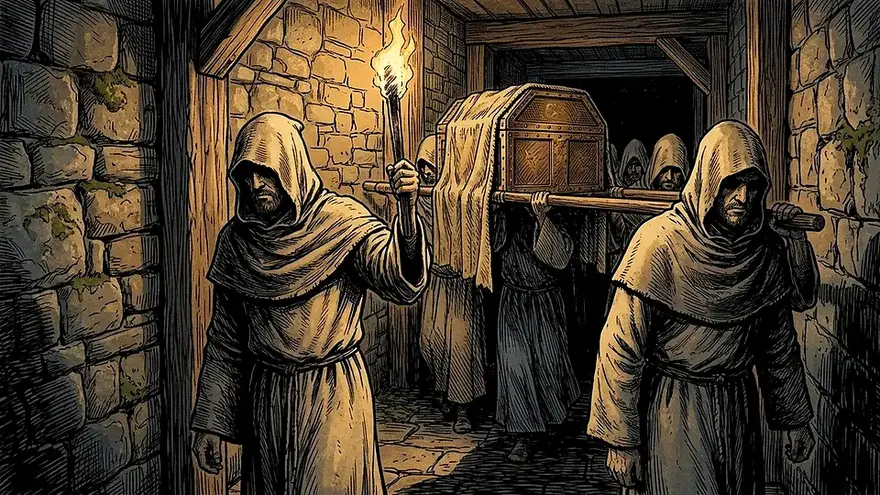
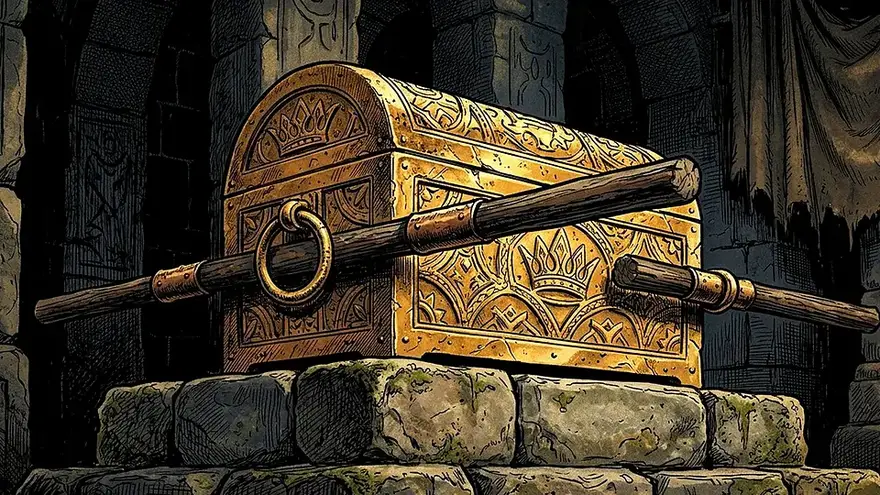
The golden rings and shoulder poles David left unused (Numbers 4:15)
Read in isolation, 2 Samuel 6:6–7 feels shocking: oxen stumble at Nacon's threshing floor, Uzzah reaches out to stop the Ark of God from tipping into the dirt, and God strikes him dead for his shal (שַׁל, 'irreverent error'). Why would heaven punish a reflex meant to protect the sacred chest?
Because the Ark should never have been balancing on a bouncing wagon at all. Centuries earlier, Exodus 25:12–15 instructed Israel to cast four gold rings on the Ark's feet and slide acacia poles permanently through them. Numbers 4:15 warned Kohathite Levites plainly: carry it on shoulders via poles, 'lest they touch the holy things and die.'
Numbers 4:15“After that the sons of Kohath shall come to carry these, but they must not touch the holy things, lest they die.”
Why It Matters: Masoretic 2 Samuel 6:7 ends with the baffling one-off syllable ha-shal ('error/irreverence'), which Dead Sea Scroll 4QSamᵃ and 1 Chronicles 13:10 reveal was a scribal truncation of 'because he stretched out (shalach) his hand upon the Ark' in violation of Numbers 4:15.
Scrolls & Archaeology: Published by Harvard paleographer Frank Moore Cross from Qumran Cave 4, 1st-century BCE scroll 4QSamᵃ (4Q51) aligns repeatedly with 1 Chronicles and the Old Greek Septuagint against damaged readings in the medieval Masoretic copy of Samuel. Three months after Uzzah's death, King David openly admitted the real root failure in 1 Chronicles 15:13: 'Because you Levites did not carry it the first time [copying the Philistines' ox-cart in 1 Sam 6:7], the LORD our God broke out against us.'
Why David copied pagan Philistines instead of Moses's Torah
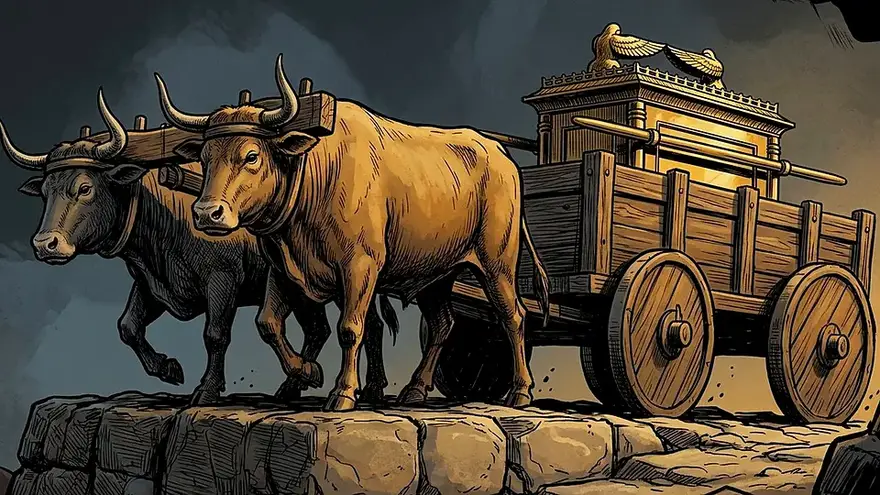
Where did King David get the idea of hauling the Ark on 'a new cart' pulled by oxen (2 Samuel 6:3)? Turn back one generation to 1 Samuel 6:7. When plagues terrified Philistine cities that had captured the Ark in battle, pagan Philistine priests built 'a new cart' pulled by milk cows because they knew nothing of Levitical law.
God spared ignorant Philistines and let the cows stop at Kiriath-jearim, where the Ark sat inside Abinadab's house for decades as Uzzah grew up beside it. Years of household familiarity bred casual handling, and David staged a flashy royal parade using Philistine logistics instead of opening Torah scrolls.
1 Samuel 6:7 & 2 Samuel 6:3“1 Sam 6:7 (Philistines): 'Now then, take and prepare a new cart.' · 2 Sam 6:3 (David): 'And they carried the ark of God on a new cart.'”
David's own confession three months later in 1 Chronicles 15:13
At first, David reacts just like modern readers—with anger (wayyichar le-David) and fear, halting the music and parking the Ark at Obed-edom's house for three months (2 Samuel 6:8–10). During that three-month pause, David evidently went back to the Law of Moses to discover why the procession failed.
First Chronicles 15:2, 12–15 supplies the crucial sequel. Summoning the Levitical chiefs, David owns the blame publicly: 'No one may carry the ark of God except the Levites... Because you did not carry it the first time, the LORD our God broke out against us, because we did not seek him according to the rule.'
1 Chronicles 15:13, 15“Because you did not carry it the first time, the LORD our God broke out against us, because we did not seek him according to the rule... And the Levites carried the ark of God on their shoulders with the poles, as Moses had commanded.”
Clean dirt vs. casual hands: understanding sacred voltage
In ancient Israel's theology, the golden mercy seat (kapporet) between the cherubim formed the earthly footstool of YHWH's invisible throne—charged with pure, uncreated holiness akin to high-voltage current or solar fire. Grabbing live voltage is fatal not out of petty malice, but because mortal rebellion cannot touch unshielded divine majesty.
As theologian R. C. Sproul famously noted, Uzzah's reflex subtly assumed that dry hillside mud was dirtier than a presumptuous human hand. Mud simply obeys gravity and does everything God created it to do; treating God's presence as a manageable political prop is what profanes the holy.
2 Samuel 6:2“And David arose and went with all the people... to bring up from there the ark of God, which is called by the name of the LORD of hosts who sits enthroned on the cherubim.”
Torah Ark Law vs. David's Two Attempts
Comparing Moses's explicit instructions against David's failed first parade and corrected second procession.
| Requirement | Torah Law (Exod 25; Num 4 & 7) | Attempt 1 (2 Samuel 6:1–8) | Attempt 2 (1 Chronicles 15:2–15) |
|---|---|---|---|
| Vehicle Allowed? | None—no carts given to Kohathites (Num 7:9) | Placed on a 'new ox-cart' like Philistines | No cart; carried strictly on foot |
| Who Carries It? | Consecrated Kohathite Levites on shoulders | Driven alongside cart by Uzzah & Ahio | Sanctified Levites hoist acacia poles |
| Direct Hand Contact | Strictly forbidden on pain of death (Num 4:15) | Uzzah grabs the Ark when oxen stumble | Zero hand contact; gold rings & poles used |
| Outcome | Safe dwelling of YHWH among Israel | Perez-uzzah ('Outburst against Uzzah') | Joyful arrival in Jerusalem without harm |
What to Remember
- Exodus 25:12–15 and Numbers 4:15 permanently fitted the Ark with rings and shoulder-poles and warned Levites never to touch it 'lest they die.'
- David copied pagan Philistine priests (1 Samuel 6:7) by putting the Ark on 'a new ox-cart' instead of consulting Moses's law.
- Three months later in 1 Chronicles 15:13, David publicly admitted the disaster happened 'because we did not seek Him according to the rule.'