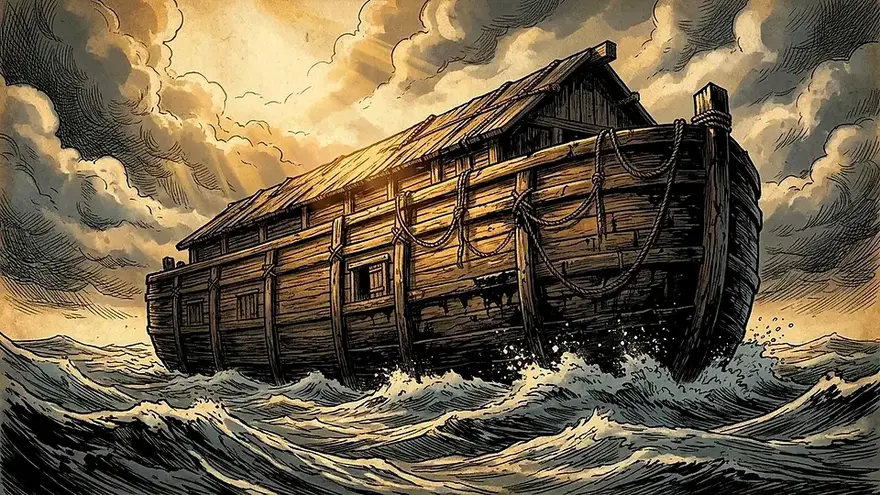
Biblical Hebrew has no separate word for 'planet Earth'; its noun eretz means both 'earth' and 'regional land/country,' so kol ha-aretz ('all the earth/land' in Genesis 7:19; 8:9) regularly describes the known Near Eastern horizon—as proven by Genesis 41:57 ('all the earth came to Egypt to buy grain'). Readers weigh universal de-creation imagery against regional Mesopotamian deluge markers.
One Hebrew word ('eretz') for planet and country—tested by Genesis 41:57
Modern readers picture NASA's blue marble spinning in space whenever an English Bible prints 'all the earth.' Ancient Hebrew, however, possessed one flexible noun—eretz—covering dirt underfoot, a single tribal district, the Fertile Crescent, or the terrestrial world. Context alone decides which scale applies.
Turn thirty-four chapters past Noah to Joseph's famine in Genesis 41:57: 'All the earth (kol ha-aretz) came to Egypt to Joseph to buy grain, because the famine was severe over all the earth.' Nobody imagines Olmec farmers paddling from Mexico to Cairo; like Deuteronomy 2:25 ('peoples under the whole heaven'), Hebrew universal phrases routinely describe the speaker's entire known world.
Genesis 41:57 & Deuteronomy 2:25“Genesis 41:57 — 'All the earth (kol ha-aretz) came to Egypt to Joseph to buy grain, because the famine was severe over all the earth.' · Deuteronomy 2:25 — 'The peoples who are under the whole heaven.'”
Why It Matters: Biblical Hebrew uses one word ('eretz) for both 'earth' and 'regional country' (proven by Gen 41:57, 'all the earth came to Joseph'), while 1611 English 'replenish' (from Old French remplir) simply meant 'fill'—used identically in Genesis 1:28 before anything died!
Scrolls & Archaeology: Nineteenth-century 'Gap Theory' writers built an entire pre-Adamic catastrophe doctrine on KJV's 'replenish the earth' in Genesis 1:28 and 9:1, unaware that in Jacobean English replenish carried zero prefix sense of 'fill a second time' (translating plain Hebrew mil'u, 'fill full'). Notice also Genesis 8:4's plural geography: Noah's ark comes to rest 'upon the mountains of Ararat' ('al harei 'Ararat)—the Iron Age highland kingdom of Urartu spanning eastern Turkey and Armenia, centuries before medieval Christian pilgrims attached the name to modern Agri Dagi.
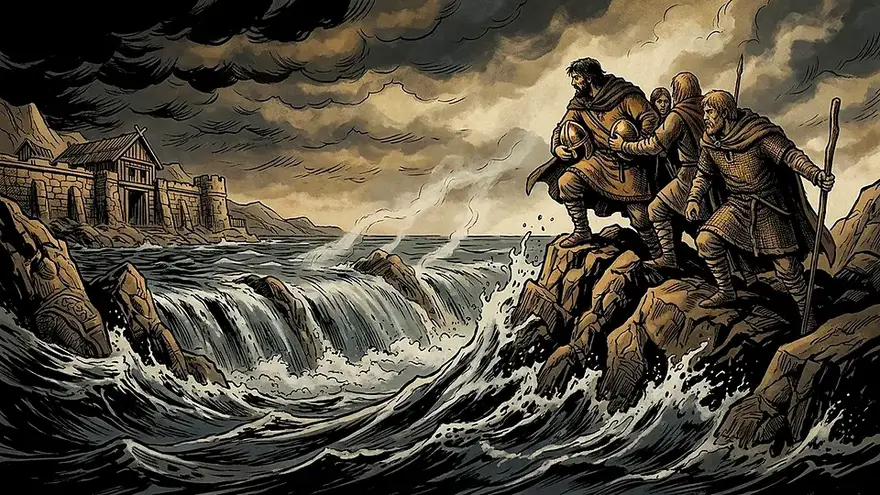
Weighing Genesis 7:19–20: planetary waters vs. Mesopotamian basin deluge
Global-flood readers point to Genesis 7:19–20: waters rise fifteen cubits (~22 feet) above 'all the high mountains under the whole heaven,' Noah's vessel floats for a full year, and 2 Peter 3:6 pairs the watery judgment of the ancient kosmos with future cosmic renewal.
Regional-deluge scholars answer from Hebrew usage and Near Eastern geology. Hebrew harim covers low hills as well as peaks; fifteen cubits equals half the Ark's thirty-cubit hull height (its loaded draft clearance); Genesis 8:4 lands on the 'mountains of Ararat' (ancient Urartu's foothills); and thick riverine flood silt excavated by Leonard Woolley at Ur and Shuruppak (~2900 BCE) attests colossal Mesopotamian basin floods.
Genesis 7:19–20 & 8:4“And the waters prevailed so mightily on the earth (ha-aretz) that all the high mountains under the whole heaven were covered. Fifteen cubits deep the waters prevailed... the ark came to rest on the mountains of Ararat.”
George Smith's 1872 stunner: Gilgamesh Tablet XI and Atrahasis
In December 1872, British Museum engraver George Smith translated a broken cuneiform tablet from Nineveh and startled Victorian London. Tablet XI of Gilgamesh (building on the older Atrahasis epic) told how Utnapishtim sealed a multi-deck vessel with pitch, survived a cataclysmic deluge, released a dove, swallow, and raven, and sacrificed atop a mountain.
Yet the theological clash is sharp. In Atrahasis, noisy humans ruin storm-god Enlil's sleep, terrified gods cower 'like dogs crouched against a wall,' and starving deities swarm Utnapishtim's sacrifice 'like flies.' Genesis strips out divine pettiness: one righteous Creator grieves over human violence (chamas, Genesis 6:11) and preserves life by covenant.
Genesis 6:11–14“Now the earth was corrupt in God's sight, and the earth was filled with violence (chamas)... 'Make yourself an ark of gopher wood. Make rooms in the ark, and cover it inside and out with pitch.'”
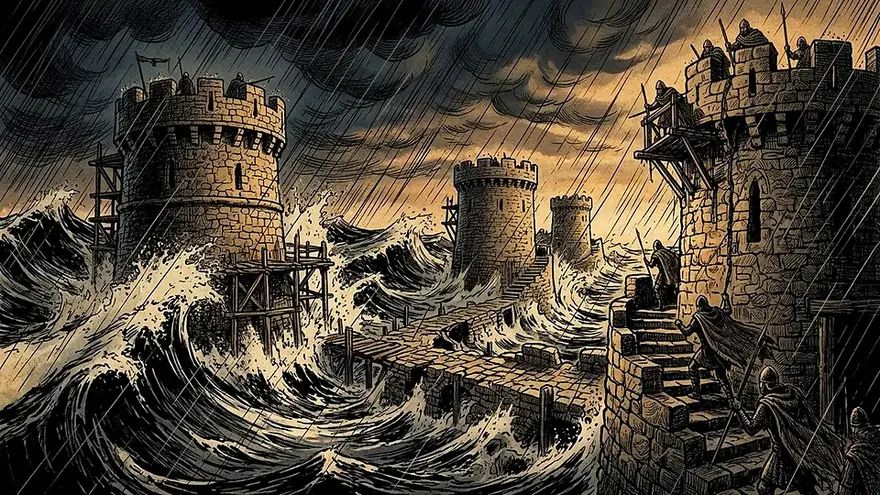
Cosmic de-creation and Day One replayed in Genesis 8:1
Whether one pictures global ocean or a drowned Near Eastern world, Genesis 6–9 unfolds as cosmic de-creation and rebirth. In Genesis 1, God separated waters above the sky-dome from seas below so dry ground appeared; in Genesis 7:11, both barriers burst open as 'the fountains of the great deep (tehom) burst forth, and the windows of the heavens were opened.'
Then Genesis 8:1 replays Genesis 1:2: God remembers Noah and sends a ruach ('wind/Spirit') sweeping across the waters until dry land emerges, animals disembark, and Noah receives Adam's exact commission—'Be fruitful and multiply and fill the earth' (Genesis 9:1).
Genesis 7:11 & 8:1“Genesis 7:11 — 'On that day all the fountains of the great deep (tehom) burst forth, and the windows of the heavens were opened.' · Genesis 8:1 — 'God remembered Noah... and God made a wind (ruach) blow over the earth.'”
Genesis 6–9 vs. Babylonian Flood Tablets (Atrahasis & Gilgamesh XI)
Shared Mesopotamian memories paired with radical Hebrew theological contrasts.
| Feature | Babylonian Flood Epics | Genesis 6–9 (Hebrew Torah) |
|---|---|---|
| Why the Flood Came | Noisy human overpopulation disturbs god Enlil's sleep | Pervasive moral corruption and bloodshed (chamas, Gen 6:11) |
| Vessel Shape & Pitch | Huge cube-shaped barge sealed with bitumen pitch | Rectangular chest/barge (300×50×30 cubits) sealed with pitch |
| Scouting Birds Sent Out | Dove, swallow, then raven (Gilgamesh XI) | Raven first, then dove three times returning with olive leaf |
| Divine Reaction at Sacrifice | Starving, terrified gods crowd around roast meat 'like flies' | Sovereign YHWH smells soothing aroma and pledges rainbow oath |
| Hero's Final Fate | Utnapishtim granted rare immortality far from humanity | Mortal Noah plants a vineyard and fathers post-Flood nations |
What to Remember
- Hebrew kol ha-aretz ('all the earth/land') and 'under the whole heaven' frequently function as horizon-universal idioms in Scripture, as in Genesis 41:57 and Deuteronomy 2:25.
- Nineteenth-century excavations at Nineveh uncovered Babylonian flood tablets (Atrahasis and Gilgamesh XI) sharing pitch-sealed arks and scouting birds while clashing sharply with Genesis's moral theology.
- Literarily, Genesis 7–8 reverses the watery separation of Genesis 1:2–9 back into primeval tehom ('deep') before starting a new creation with Noah as a second Adam.